1945 Air Force: Plane Shooter
- 4.8
- Rating
- 100.00M
- Installs
- Free
- Price
 Analysis by App-foxy
When I play 1945 Air Force: Plane Shooter, the first thing I notice is how quickly it turns a spare minute into a focused arcade session. I guide a fighter through incoming formations, keep my attention on the firing lane, and make small movement decisions constantly. It is free to start, made by 1SOFT, and sits firmly in the classic shoot-’em-up tradition rather than trying to become a full simulation of aviation.
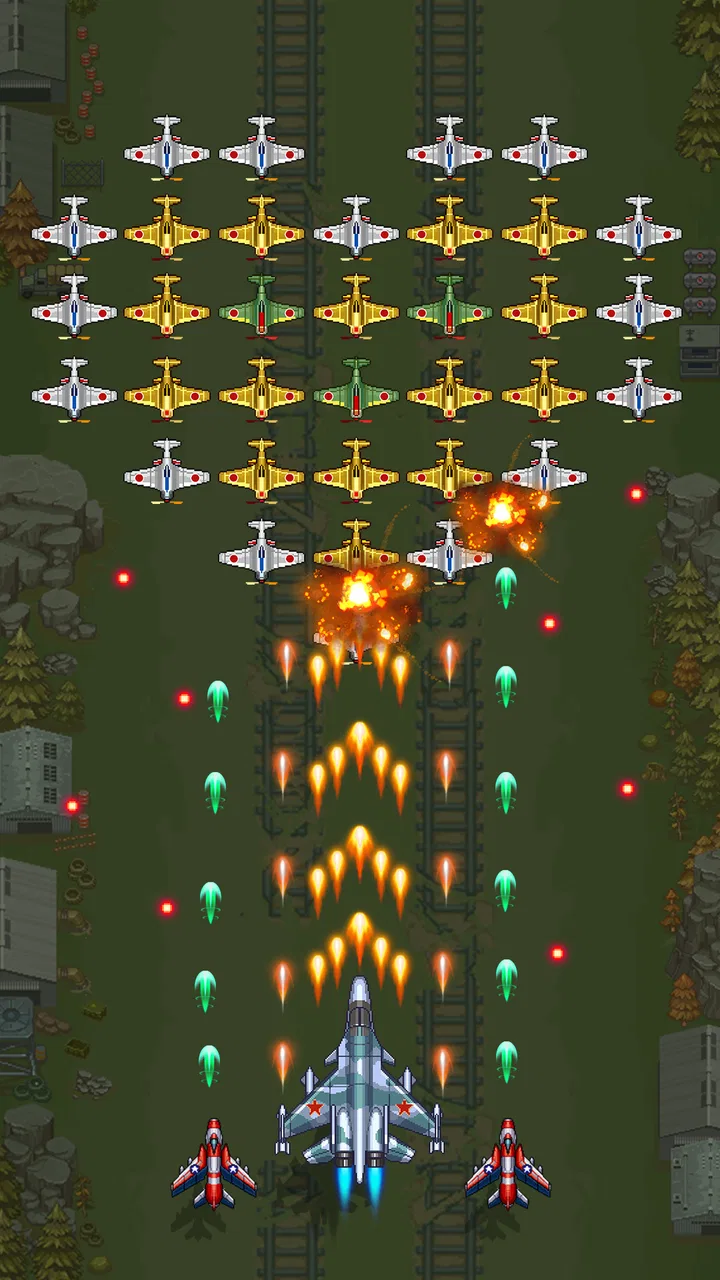
The central capability is simple but important: the game lets me concentrate on controlling the aircraft while the weapon action keeps the screen busy. That division of attention creates its own rhythm. I am not spending every second choosing a target manually, yet I still need to position the plane carefully, avoid hazards, and react to what is approaching. In my experience, this makes the game easy to understand during the first session but much less effortless once the screen becomes crowded.
Its store summary invites players to master the skies and join the air force, but my reason to return is more practical. The game works well when I want a quick arcade challenge with recognizable aircraft combat imagery, short bursts of concentration, and enough pressure to make a replay feel meaningful. It is not the right pick if I want a slow, realistic flight experience or a story-heavy war game.
You May Also Like

 Blood Strike: 2.5 Anniversary
Blood Strike’s Loadouts Turn Every Drop Into a Tactical Gamble
A close look at Blood Strike’s custom loadouts: how fast access to signature weapons reshapes its battle royale rhythm, rewards preparation, and narrows the gap between fights.

 Pandora - Music & Podcasts
Pandora’s Music Is Easy to Start, but Harder to Recover
Pandora’s strength is its low-effort path from a seed to a station. Its weak spot is how much confidence it asks you to place in connection, setup, and quiet recovery.

 8 Ball Pool
 Is Built on Rivalries, Rematches, and Routine
A close look at the rivalries, rematches, shared routines, and unanswered safety questions that turn a quick pool match into a persistent mobile community.

 Samsung Music
’s Quiet Strength Is Playing What You Already Own
Its reach comes less from spectacle than from dependable access to a personal library. That simplicity is both the app’s strongest retention engine and its ceiling.

 AccuWeather: Weather Radar
AccuWeather Review: A Quick, Clear Forecast for Everyday Decisions
For everyday plans, the best forecast is the one you can understand quickly. AccuWeather makes rain timing, radar, and local conditions easy to act on, with a few trade-offs.

 Hill Climb Racing
Why Hill Climb Racing Still Turns Crashes Into One More Run
A tiny car, a bumpy hill and one more upgrade: Hill Climb Racing keeps resurfacing because its simple chaos makes every near-miss feel personal.
More From Our News Desk
View All News


Why the shooting-and-positioning loop works
The most effective part of the design is the relationship between automatic offensive pressure and manual movement. Because I can focus on steering, the important question is rarely “which enemy should I tap?” Instead, I am asking whether my current position will keep the firing line useful while also giving me room to escape. That sounds small, but it changes the feel from a simple target-tapping game into a test of spacing and timing.
I have found that staying near the center of the screen is not always the safest choice. It gives me room on both sides, but it can also leave me reacting late when threats arrive from different directions. Moving too far toward an edge creates the opposite problem: I may avoid one danger while giving myself fewer escape options. The practical lesson is to make small adjustments early rather than waiting until the aircraft is already trapped.
This is where the arcade category suits the game. The controls are built around immediate decisions, not long preparation. I can begin a run without studying a complicated cockpit or learning a realistic control scheme. At the same time, the familiar format rewards attention. A player who simply holds one direction will quickly discover that survival depends on reading patterns, preserving space, and resisting unnecessary movement.
The visual action can become busy, so I try to watch the spaces between threats rather than stare at every individual object. Looking for a clear route is more useful than chasing every possible target. That habit also helps when I am playing on a smaller phone, where a dense screen can make individual details harder to separate. The game feels best when I treat movement as the main skill and shooting as the constant background pressure.
What a normal session feels like
A typical session begins casually. I might open it while waiting for a bus or taking a short break, expecting to play briefly. The first run usually feels approachable because the basic goal is immediately clear: keep the plane alive and continue attacking. After a mistake, however, I often want another attempt because I understand exactly what went wrong. I moved too late, entered a narrow path without an exit, or focused on an attractive target instead of the safer route.
That clarity is one of the strongest reasons to try it. A defeat does not usually feel mysterious. I can connect the result to a decision I made a few seconds earlier. This gives the arcade loop a useful sense of accountability without requiring a long tutorial or a complicated explanation.
Playing with one hand is possible for short periods, but I prefer a stable grip and a clear view of the display. Fast corrections are easier when my thumb is not covering too much of the action. If I am using a phone while walking, I would skip the game entirely; the concentration required for crowded moments makes it a poor companion for divided attention.
The game is also a better fit for repeat sessions than for one extended campaign-style sitting. Its appeal comes from improving how I handle the next run, not from slowly uncovering a single dramatic narrative. That distinction matters if you are deciding between this and a story-led mobile title. Here, the reward is the feeling that my control is becoming cleaner.
A useful everyday scenario
Imagine having ten minutes before an appointment. I can launch the game, play one focused attempt, and stop without needing to remember a complicated plot or rebuild a large setup. If the run ends quickly, I can put the phone away without feeling that I abandoned an important mission. If I have more time, I can try again with one specific goal, such as staying calmer near the edges or saving movement space for the busiest section.
That makes it especially convenient for players who like measurable personal improvement. I do not need a long uninterrupted evening to enjoy it. A small target for each session keeps the experience from becoming mindless repetition: improve positioning, avoid panic movements, or learn to recognize when the safest route is not the most aggressive one.
There is also a social use case, even without turning the game into a formal competition. I can hand the phone to a friend and explain the basic idea in seconds. The immediate action makes it easy to compare approaches: one person may play aggressively and chase targets, while another may survive longer by protecting open space. That difference creates conversation because the controls are simple but the decisions are not identical.
Where progression and spending affect the experience
The game is free to download, which lowers the barrier to trying it. It also includes in-app purchases ranging from $0.99 to $199.99 per item. That wide range is worth keeping in mind before spending anything. I would approach purchases as optional convenience or support rather than assuming that paying is necessary to understand whether the core flying loop suits me.
My advice is to play long enough to identify the exact friction you are trying to solve before buying. If the real problem is poor positioning, a purchase may not improve the experience because the underlying mistake remains. If you enjoy the game and want to invest in it, set a personal limit first. This is particularly sensible for a title that can encourage “one more attempt” thinking.
The current version is 15.22, and the game has been available since March 5, 2019. That history helps explain why it feels like an established mobile arcade product rather than a short experimental release. It has had time to attract a large audience, but popularity should not be confused with universal suitability. The core loop still depends on whether you enjoy repeated action and gradual improvement.
The audience response is strong: it holds a 4.8 average from around 4.2 million ratings, with roughly 49 thousand written reviews and over 100 million installs. I read those figures as evidence that the format has broad appeal, not as proof that every player will enjoy it. People who dislike repetition, pressure, or touch-based steering may still find the same qualities tiring.
The tradeoff between accessibility and depth
The easy-to-grasp controls are a genuine strength, but they also define the limit of the experience. I can understand the objective immediately, yet that does not mean every part of the game feels equally deep. The challenge comes primarily from execution, timing, and adapting to the action rather than from building a complex tactical plan.
That is satisfying when I want direct arcade play. It is less satisfying when I am looking for detailed aircraft management, realistic flight behavior, or a large strategic layer. A conventional flight simulator would be a better choice for learning cockpit procedures and aircraft handling. A slower strategy game would suit someone who wants to make decisions away from the action. This title is for the player who wants the screen moving now.
Another tradeoff is attention. The constant action keeps the game lively, but it can also become tiring during longer sessions. I prefer playing in short blocks because my reactions become less precise when I continue after frustration sets in. Taking a break is not just good for comfort; it can improve the next attempt because I return with a clearer view of safe movement routes.
Touch controls also make the experience dependent on the phone itself. A responsive display and a comfortable grip help, while a cramped screen or awkward hand position can make precise corrections harder. I would not judge the game fairly after playing while distracted or while the device is difficult to hold. The aircraft may be simple to control, but crowded moments still demand physical accuracy.
Small habits that improve play
My first practical tip is to prioritize escape space over immediate damage. It is tempting to move toward the most rewarding-looking target, but a route that leaves no exit can turn a good position into a sudden loss. I try to ask where the plane can go next before committing to a movement. This one-second habit makes the action feel more deliberate.
Second, I avoid making large corrections unless the current path is clearly unsafe. Frequent sweeping movements can create new problems because I lose track of the open lane I was using. Small adjustments preserve control and make it easier to change direction again. This is especially useful for new players who initially react to every object as though it requires an emergency maneuver.
Third, I use each failed run to identify one mistake rather than reviewing everything at once. If I focus on edge positioning in one attempt and timing in the next, improvement feels more concrete. Trying to fix every weakness simultaneously usually makes me tense, and tense movement is exactly what the game punishes.
Finally, I keep the volume and visual surroundings comfortable. The action is easier to read when I am not playing in a distracting environment, and I avoid using it when I need to watch where I am walking. These are ordinary choices, but they matter because the game’s main challenge is sustained attention rather than complicated controls.
Who will get the most from it
I would recommend it first to fans of classic arcade shooters who enjoy repeating a run to sharpen their reactions. It is also a good entry point for someone who wants an airplane-themed game without learning realistic aviation controls. The Everyone 10+ age rating makes it suitable for a broad audience, although younger players may still need guidance around optional purchases and the intensity of repeated play.
It can work for casual players too, provided they enjoy action that asks for focus. The free entry makes experimentation easy, and a short session can provide enough entertainment without demanding a major time commitment. I would especially suggest it to someone who likes games where the improvement is visible in their own decisions rather than dependent entirely on unlocking a new story chapter.
I would steer you elsewhere if your priority is realism. The game presents an arcade interpretation of aerial combat, so it should not be treated as a substitute for a flight simulator. I would also suggest another genre if you want deep planning, quiet exploration, or a campaign that carries emotional weight from one mission to the next. Its strengths are immediate control and repeatable pressure, not simulation or narrative.
Players who are sensitive to monetization should take a measured approach. Since optional items can reach $199.99, I would not hand the game to a child without discussing purchase settings first. The best way to enjoy it is to decide whether the basic loop is fun before considering any payment. If the steering, survival pressure, and replay cycle already feel rewarding, the free version gives a clear starting point.
My final take after focusing on its real strength
For me, the defining feature is the way continuous shooting leaves movement as the main expression of skill. That choice keeps the game readable, fast, and easy to start, while still giving experienced players something to refine. I remember the good runs because I found a clean route through pressure, not because I memorized a complicated menu.
The best reason to play is the satisfying link between a small movement decision and a better survival result. That link makes short sessions worthwhile and gives failures a useful lesson. The cost is that the experience can feel repetitive or demanding if I want variety outside the arcade loop.
With its free price, broad audience, and long-running presence, 1SOFT’s airplane shooter is easy to recommend as a trial. I would start without spending, play in focused sessions, and judge it by whether I enjoy improving my positioning. If I do, it becomes a dependable quick-play game. If I want realism, slower strategy, or a story-led adventure, I would choose a different kind of aircraft game instead.
FAQs for 1945 Air Force: Plane Shooter
01What is the main objective of 1945 Air Force: Plane Shooter?
The main objective of 1945 Air Force: Plane Shooter is to pilot a fighter aircraft and engage in thrilling aerial battles. Players must navigate through various missions, shooting down enemy planes, dodging attacks, and collecting power-ups to enhance their aircraft's capabilities. The game is designed to challenge your reflexes and strategic thinking.
02Is 1945 Air Force: Plane Shooter free to play?
Yes, 1945 Air Force: Plane Shooter is free to download and play on both Android and iOS platforms. However, the game includes optional in-app purchases. These purchases can enhance gameplay by offering additional planes, upgrades, and other features that may accelerate progress or improve your gaming experience.
03What are the system requirements for 1945 Air Force: Plane Shooter?
For optimal performance, 1945 Air Force: Plane Shooter requires Android devices running version 4.4 or higher and iOS devices with iOS 9.0 or later. Ensure your device has sufficient storage space and a stable internet connection for smooth gameplay, especially if you plan to engage in online multiplayer modes.
04Does the game offer multiplayer features?
Yes, 1945 Air Force: Plane Shooter includes a multiplayer mode that allows players to compete against others in real-time. This feature adds a competitive edge to the game, enabling you to test your skills against players worldwide. Make sure your internet connection is stable to enjoy seamless multiplayer battles.
05Are there any ads in 1945 Air Force: Plane Shooter?
1945 Air Force: Plane Shooter does contain ads, which help support the free-to-play model. Advertisements may appear between missions or when accessing certain features. Players can opt to remove ads by purchasing an ad-free version via in-app purchases, providing a more uninterrupted gaming experience.
Pros
- Engaging retro-style graphics.
- Smooth and responsive controls.
- Variety of planes to unlock.
- Challenging boss battles.
- Frequent updates with new content.
Cons
- In-app purchases can be pricey.
- Repetitive soundtrack.
- Ads can be intrusive.
- Requires steady internet connection.
- Limited offline gameplay options.

1945 Air Force: Plane Shooter
Gallery